Shipping will be limited from June 13 to June 30. We will begin shipping orders on July 1, 2026.

Pyramid Placement

Basic guidelines:

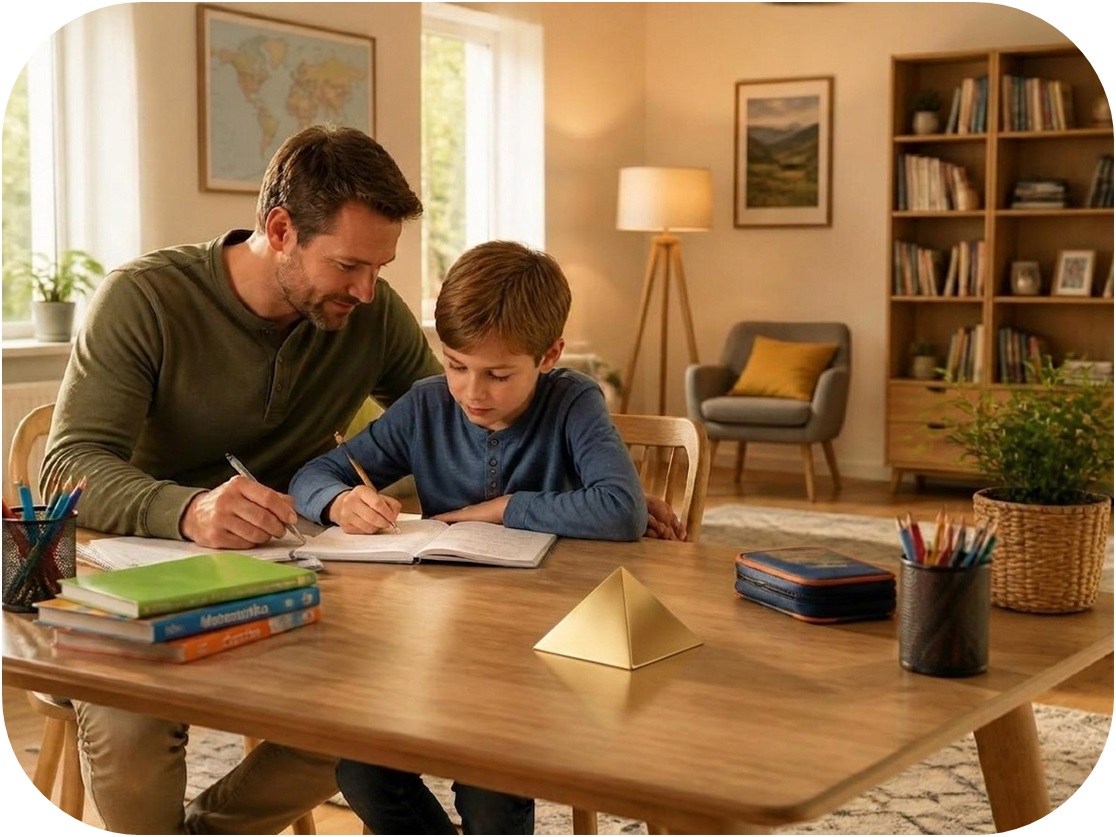
  • In general place your pyramid on a table off the ground to optimise energy circulation.
  • If possible place it toward the centre of the room away from the wall.
  • Think about electrical and magnetic interferences coming from cabling, wifi routers, computers, DECT phones, or smart metres, and avoid placing the pyramid close to such places.
  • Consider what you are placing your pyramid next to, and if it shares a space on a larger table, try and give it a clear area of its own. You can position crystals close to it as part of an intended set up to enhance the field interaction, as intuition allows, or position archetypal images or symbols such as sacred statues, geometry glyphs and so on. This can be done by following what is resonant, while holding a soft intention or aim for the pyramid e.g. a general intention to balance, stabilise and cohere the field, or something more specific like an intention for the set up to support healing and spiritual growth.


The type of surface the pyramid sits on modulates its action, and it is helpful to understand some of the basic differences as different surfaces enhance different outcomes. While for the most part, if one is following the law of resonance, it isn’t always necessary to know (since if it feels right, then it is right for you now), there are times when it is useful to arrange a pyramid set up with more focused awareness, especially if you already know the direction of outcome you intend.

Glass

A titanium pyramid placed on a glass surface creates a self contained resonance loop. This configuration is ideal for meditation, breath work, or symbolic activation, as the field remains highly responsive to your presence.

Glass acts as an insulator, preventing the field from contracting downward into the Earth. Instead, the field is forced to expand horizontally—creating a wave-like resonance beneath the glass; the field is trapped and oscillating within the glass-pyramid system, rather than grounding. Because the pyramid is reflecting and containing harmonic energy without allowing it to dissipate downward, it is ideal for intention amplification, breath coherence, and symbolic mirror work, as the field remains contained and responsive to your awareness.

Symbolic activation is the use of a symbol, in this case a pyramid symbol, as a key to unlock a dormant harmonic field within yourself or the environment. Symbolic activation requires intention; it emerges once you have asked for a specific outcome e.g. to heal, to manifest more effectively, or to gain deeper personal insight.

Your intention becomes a tuning signal, which then instructs the pyramid what harmonic aspect within yourself to reflect back into your awareness. Intention activates the potential of the pyramid, leading to enhanced outcome.

With intention, any conscious engagement with the pyramid e.g. through breath work or meditation, causes you to phase-lock with it, and once this happens it more actively, and more specifically, engages your personal field, allowing you to remember your own geometry i.e. gain deeper awareness about your life purpose, past lives, life lessons and so on.

Wood

Wood is an organic material and a natural insulator. It grounds the pyramid's field while also allowing for a subtle exchange of energy. It helps anchor the pyramid's field into the local environment. This surface is suited when your aim is to stabilise and make more coherent the local field e.g. in a room or house. The wooden surface supports, and partially insulates, the titanium pyramid’s field. This allows the field to stabilise and cohere without being disrupted by external noise. This combination provides a good balance between structure and flow, which is essential for field coherence.

This set up is ideal for local field coherence and stabilisation. It will still have a direct influence on personal field stabilisation and coherence, but it won’t be focused entirely on you; it will also be working with the room and the building it is in, as well as other people in it.

Stainless Steel

Stainless steel is highly reflective, both visually and energetically. This means it will reflect the pyramid’s field back upward, potentially intensifying the upward vector. It is also highly conductive, and unlike wood, which insulates and grounds, steel will allow the pyramid’s field to interact more directly with the surrounding environment and any nearby electrical or magnetic fields. If the stainless steel contains iron (as many grades do), it will interact with magnetic fields. This could create complex interference patterns with the pyramid’s field, especially if there are nearby magnetic sources.

In our view, stainless steel for placement is potentially useful, while also having potential drawbacks, so we do not recommend you place your titanium pyramid on stainless steel if you are a beginner. The more advanced person may on occasion find this set up useful, especially if a stronger upward spiral or vortex is desired to enhance activation or ascension-oriented practices, but please bear in mind that without skilful field testing, the set up could generate some field distortion and destabilisation, which is undesirable.

Stone

Stone can act as a matrix or “body” for the pyramid’s field. The density, crystalline structure, and mineral composition of the stone will influence how the field is absorbed, reflected, or stabilised. Stone can provide grounding and insulation, but its properties vary, some stones are more conductive, while others are more insulating, affecting how the field couples with the Earth and local environment.

Granite is very dense, crystalline, and provides a strong resonance field interaction; it acts as a powerful field stabiliser, and its crystalline structure can amplify and hold coherent frequencies. The King’s Chamber in the Great Pyramid, made entirely of granite, is described as radiating “prodigious energy and power,” suggesting its ability to stabilise and intensify breath fields. It is ideal for high-energy breath work, field anchoring, and long-term coherence.

Marble is recrystallised limestone. Its softer than granite, often with veining, and less crystalline. As such it provides a softer, more fluid grounding than granite. Its calcium carbonate base can interact with breath-based activations in a more subtle and emotional way, and may be better suited for emotional integration or heart-centred living-field practices.

Onyx is a form of chalcedony, which is a form of quartz with parallel bands. Its dense, fine-grained, and often black, dark or green/brown. Onyx is known for its grounding and protective qualities. It can absorb and transmute negative or chaotic energies, making it ideal for shielding or clearing applications. It may be useful for stabilising the field during shadow work or deep emotional release.

Travertine, often used for table making, is porous limestone, and lighter and less dense than marble or granite. It off ers a more “breathable” grounding, allowing for a more gentle field exchange, and thus ideal when you want a less intense field interaction that is both grounded and insulated.